Gos
H is for HawkGos, T. H. White’s young male goshawk, is at once a wild bird in a difficult training relationship and the unresolved loss around which White’s account gathers. White’s efforts to make him return to the fist repeatedly expose the gap between human plans and the bird’s independent needs. When Gos disappears, White cannot know whether he survives; that uncertainty gives the loss a continuing life in the book and, later, in Helen Macdonald’s reading of it.
Identity and reputation
Gos belongs to a kind of hawk that falconry writing had often cast as difficult, solitary, and ill-tempered. The contrast was partly social: goshawks could be flown in relatively confined settings, while falcons required extensive open land, access more readily available to wealthy or well-connected falconers. Historical accounts consequently elevated the falcon as noble and disparaged the goshawk and the solitary austringer who trained it. Gos enters White’s story within that inherited language of unruliness, but the events of his training also make the limits of such descriptions plain. His actions have their own immediate logic: he approaches for food when hungry, resists when he does not want to return, and seeks a higher perch when the opportunity presents itself.
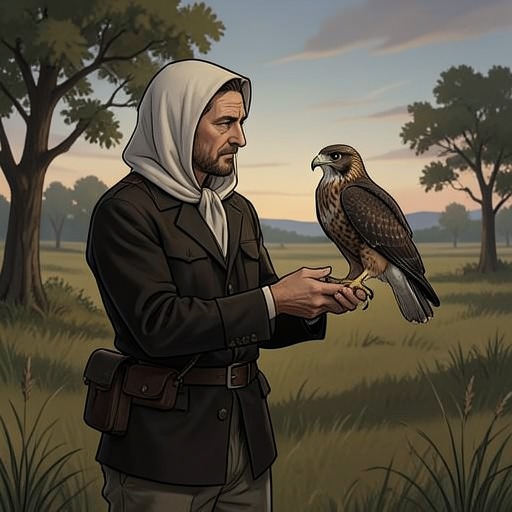
Gos is a young bird familiar with humans and initially willing to approach White for food. On the first night, after White releases him in the barn, Gos steps onto his fist and eats at five minutes past three in the morning. This early readiness suggests that a relatively straightforward training might have been possible. White, however, does not understand how carefully food must be used to build trust. Concerned by pale marks across the feathers of Gos’s tail, which he recognizes as signs of earlier hunger, he feeds him too much. His attempt to compensate for the bird’s past instead leaves Gos full and uninterested in further food or contact.
White’s training and their conflict
White’s relationship with Gos develops through a repeated mismatch between human solicitude and a bird’s need for space. When Gos will not eat, White tries different foods and presses the offer, hoping patience and care will make the bird accept him. Gos’s refusals and defensive responses frustrate White, who understands them as setbacks even as the bird is responding to an intrusive presence. The cycle starts again whenever Gos becomes hungry enough to eat: White takes this as a sign that things can be made right, while his renewed attention soon alienates the bird once more.
White also approaches training through older books and an ideal of education without punishment. He has been a schoolmaster, and falconry appeals to him as a way of teaching that does not rely on the punishments he associates with conventional schooling. His interpretation of an old hawking method leads him to keep Gos awake by staying awake himself. The vigil becomes an ordeal for both. White has only six hours’ sleep in six days; exhausted, he carries Gos, speaks passages of Shakespeare, and whistles or plays music to him. He imagines the test as a contest of endurance and self-command, but his purpose does not alter Gos’s immediate need to sleep and escape handling.
White’s isolation is less complete than the imagined retreat described in his book. His cottage stands on the Stowe estate, beside an old route called the Ridings that runs toward the school. The setting complicates his sense of having left his former life behind: he remains close to the institution and role from which he hoped to withdraw. Within this landscape, the training relationship becomes entangled with White’s memories of teaching and childhood. He imagines himself as a gentler teacher who will not hurt the dependent being in his care. Gos, however, is not simply a pupil in that story; he is a wild animal whose responses cannot be made to conform to White’s hopes.
The creance, the tree, and escape
White eventually believes he has discovered a simple principle: Gos will fly to him if hungry and behave badly if not. He makes a creance from doubled tarred twine, attaches it to Gos’s swivel, and tries calling him across a distance with a familiar hymn tune. The arrangement seems to promise controlled freedom, but its practical weakness becomes evident when Gos climbs a tree with the line trailing behind him. Moving from branch to branch toward a higher perch, he pulls the twine into the branches until he is tangled and unable to return unaided. White’s attempts to reach him add to the difficulty; it takes an hour and a half, a salmon rod, and a hook to bring Gos down.
The incident does not resolve White’s uncertainty about how to train him. He continues to make plans and to interpret the bird’s responses through his own expectations. On a rainy day, hoping to give Gos more freedom, White ties the same poor-quality twine between the bird’s swivel and a bowperch outside the barn. He then leaves to attend to other tasks. When Gos bates from the barn and flies through the open door, the twine snaps. White returns to find the perch empty and the broken end of the line on the ground. Gos has escaped.
White later sees Gos at a distance, soaring in circles above the trees. He recognizes that the bird appears happy in the wild and thinks that Gos deserves his freedom, even as he fears the jesses and swivel may catch on a branch and leave him stranded. White cannot reconcile those possibilities or recover the bird. His remorse leads him to vow that, if Gos were ever returned to him, he would treat him as a partner rather than a slave. The promise marks a change in White’s understanding, but it cannot undo the escape or establish what became of Gos.
A loss that remains open
Gos’s ending is absence, not a confirmed death. White believes the equipment still attached to him could place him in danger, but the book does not show that danger becoming fact. For Helen Macdonald, this distinction is essential: Gos remains lost rather than dead, still imaginable somewhere beyond the limits of the narrative. The possibility of his return keeps the bird present in memory while preserving his separation from White.
Gos also becomes a point of connection between White’s book and Macdonald’s own experience of loss. As she reads The Goshawk while training Mabel, she sees Gos as a distant, vulnerable bird but struggles to picture White himself. Later she understands that the book mattered partly because, among the animal stories she remembered from childhood, it was the one in which the animal did not die. Her childhood image of Gos surviving in a forest gives the unresolved ending a further emotional meaning: the lost bird seems to belong to the same imagined elsewhere as other things that cannot be recovered.
The book’s final significance for Gos is therefore not that he proves White’s training successful. He does not return, and his fate remains unknowable. Instead, his resistance exposes the cost of treating a wild creature as an object to be mastered, while his disappearance forces White to reckon with the difference between care and possession. Gos remains a particular bird with needs and choices of his own, even as his absence carries the book’s wider reflections on freedom, responsibility, and grief.